Putin and Xi Show United Front at SCO Summit Amid Global Turmoil
Russian President Vladimir Putin and Chinese leader Xi Jinping reaffirmed their partnership at the SCO summit in Kyrgyzstan as global conflicts escalate.
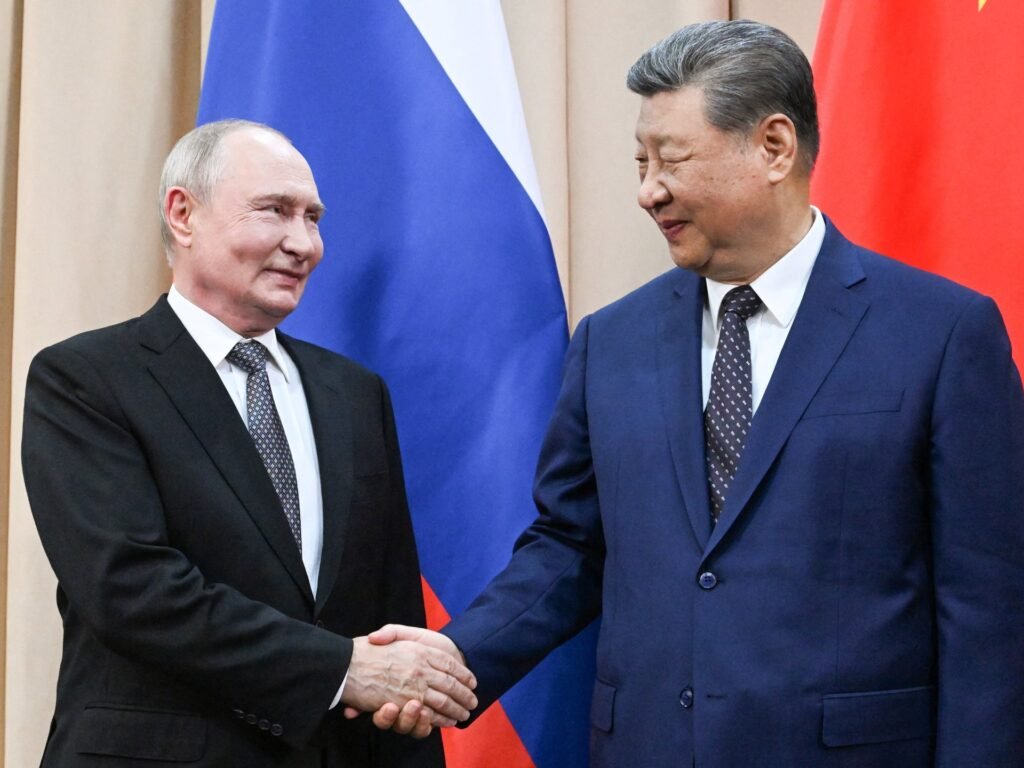
BISHKEK, Kyrgyzstan — Russian President Vladimir Putin and Chinese leader Xi Jinping put on a firm show of unity on Monday, declaring their partnership stronger than ever despite a global order fractured by multiple conflicts.
They met on the sidelines of the Shanghai Cooperation Organisation (SCO) summit in Kyrgyzstan. The date was August 31, 2026. This year marks a quarter-century of the regional alliance.
Against the backdrop of a grinding five-year-old war in Ukraine and a six-month-old conflict between the United States and Iran, the two leaders sought to project stability.
“More Solid” Ties Amid Global Turmoil
Xi told Putin he was genuinely glad to meet again, noting that their last face-to-face was back in May. He did not mince words about the state of the world.
“The amount of uncertainty and unpredictability in the international order has obviously increased,” Xi said.
Yet, he insisted that the bond between Beijing and Moscow has grown “more solid” with “even brighter” days ahead. China has repeatedly denied supplying Russia with weapons for its military campaign. Still, Western sanctions have forced Moscow to lean heavily on Beijing to keep its economy afloat.
Putin agreed with Xi’s assessment. “Cooperation is successfully developing on all fronts,” the Russian president replied.
According to Kremlin spokesman Dmitry Peskov, the two men focused primarily on trade. He told reporters they touched on the Ukraine conflict only “in passing.”
High-Stakes Side Meetings
The two-day summit in Bishkek brought together over a dozen heads of state. Host President Sadyr Japarov is presiding over a plenary session that features some of the world’s most polarizing figures. Key leaders in attendance include:
- Iranian President Masoud Pezeshkian
- Indian Prime Minister Narendra Modi
- Pakistani Prime Minister Shehbaz Sharif
- Turkish President Recep Tayyip Erdogan, attending as a dialogue partner
Putin was highly active on the sidelines. He arrived in the same car as Indian Prime Minister Narendra Modi for scheduled talks. Modi reiterated that New Delhi stands ready to help broker an end to the fighting in Ukraine.
Putin’s response was vague. He remarked that Moscow was “following the path” toward a peaceful resolution but did not elaborate.
Actual peace talks, formally backed by Washington, remain frozen. However, reports surfaced last week that CIA Director John Ratcliffe made a quiet trip to Moscow. Speculation in US media suggests Ratcliffe wanted to deliver a direct warning to Russia: do not supply arms to Iran.
The Iranian Connection
The shadow of the US-Iran war hung heavily over the summit. Iran, which has supplied Russia with drones for its invasion of Ukraine, has faced warnings from US President Donald Trump against deepening its military cooperation with Moscow.
Iranian President Masoud Pezeshkian, who is also scheduled to meet with Putin individually, expressed rare caution. Speaking to Modi after the first exchange of direct fire between US and Iranian forces in a month, Pezeshkian admitted that escalation serves nobody.
“We continue to strive for a path of agreement and understanding,” the Iranian leader said, adding that “continuing the war is neither in our interest, nor in the interest of the region.”
A Fractured but Growing Bloc
The SCO now boasts 10 full members, 15 dialogue partners—including heavyweights like Turkey, Saudi Arabia, and Qatar—and two observer states, Mongolia and Afghanistan.
On paper, the alliance is a powerhouse. It represents roughly 40 percent of the global population and a quarter of the world’s GDP.
But unity is hard to maintain. The bloc remains a patchwork of rivalries and disparate economic interests. Despite the differences, leaders like Putin and Xi have long used these summits to push back against Western dominance and advocate for a multipolar world. For Moscow, isolated by the West, this summit is a crucial lifeline.