
By Staff Writer | August 2026
Google Search is entering one of the biggest transformations in its history.
For more than two decades, the basic idea behind Google Search was simple: type a query, receive a page of links, and visit websites to find the information you need. That model is now changing rapidly as Google integrates artificial intelligence directly into the search experience.
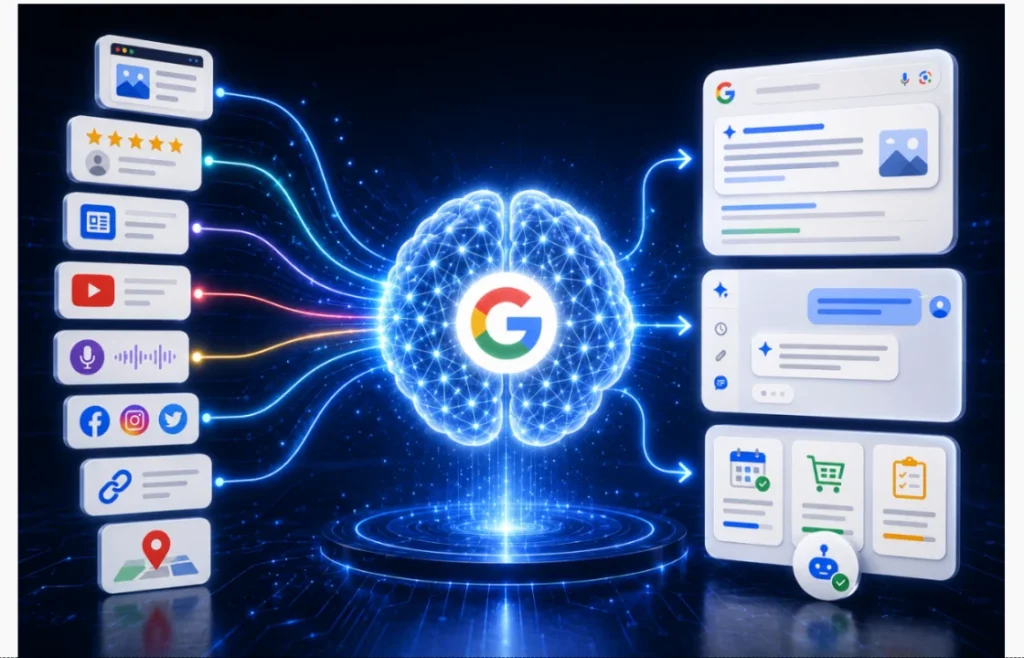
In 2026, Google is moving toward a more conversational and AI-powered Search experience built around AI Overviews, AI Mode, multimodal search, personalized sources and emerging search agents.
At Google I/O 2026, the company described its latest changes as the biggest upgrade to the Search box in more than 25 years. The redesigned experience allows users to search using combinations of text, images, files, videos and Chrome tabs, while continuing to provide traditional web results alongside AI features.
The shift could change not only how people search for information, but also how websites, publishers, businesses and creators compete for online visibility.
From Search Engine to AI Research Assistant
Traditional search engines were designed primarily around keywords.
If someone wanted to know the best laptop for college, for example, they might search phrases such as “best laptop for students” and then open several websites to compare specifications, prices and reviews.
AI Search changes that process.
Instead of breaking a question into multiple searches, users can increasingly ask Google a detailed question in natural language and continue the conversation with follow-up questions.
Google’s January 2026 update made this transition more obvious by connecting AI Overviews directly with AI Mode. Users can begin with an AI-generated overview and then move into a conversational experience while keeping the context of the original question.
The result is a search experience that feels less like navigating a directory and more like interacting with an intelligent research assistant.
AI Mode Is Becoming the Center of Google’s New Search Strategy
One of the most important components of Google’s AI Search strategy is AI Mode.
Google says AI Mode has surpassed one billion monthly active users globally, while queries in AI Mode have more than doubled every quarter since its launch. The company also says overall Search usage has reached record levels.
AI Mode is designed for questions that require more reasoning, exploration and context than a traditional search query.
Rather than simply matching a few keywords, Google’s systems can break a complex question into multiple related searches and investigate different parts of the topic simultaneously.
This approach, which Google has described as “query fan-out,” allows Search to explore multiple subtopics before constructing an answer.
For users, that could mean fewer individual searches and less time jumping between pages.
For website owners, however, it introduces a new challenge: how do you get your content discovered and cited when an AI system is answering the question before the user reaches the traditional results?
Google Wants AI Search to Keep the Web Relevant
The rise of AI-generated answers has created concerns across the publishing and SEO industries.
If users receive a detailed answer directly inside Google, they may have less reason to click through to individual websites.
Google argues that its AI Search features are designed to send users deeper into the web rather than replace it.
In June 2026, Google said AI Overviews had more than 2.5 billion monthly active users and AI Mode had passed one billion monthly users. The company also said it was increasing the number of links within AI responses and adding website previews to encourage users to explore original sources.
Google has also introduced features designed to make original sources easier to discover.
That includes Preferred Sources, which allows users to identify websites they want to see more prominently in AI Search experiences.
Google says users are twice as likely to click a Preferred Source, while more than 345,000 unique sources had already been selected by users.
For publishers, that could make reputation and original reporting increasingly important.
A New Opportunity for News Websites
News publishers may be among the biggest groups affected by Google’s AI transformation.
Breaking-news searches require fresh information, multiple perspectives and frequent updates. Google has been testing ways to incorporate news and Top Stories more prominently into AI-powered search results.
In July 2026, Google rolled out Top Stories within AI Overviews for mobile users in the United States, giving developing-topic searches more prominent access to news coverage.
This development is particularly significant because AI Search needs fresh information for topics that change rapidly.
A static article from several months ago may be useful for background information, but it cannot necessarily explain what happened an hour ago.
That creates an opportunity for publishers that consistently produce accurate, original and timely reporting.
Search Is Becoming Multimodal
Another major change is that Search is no longer limited to typed words.
Google’s new Search experience allows users to combine different forms of information, including text, images, files, videos and browser content.
This means a user could potentially show Google an image, add a written question and use information from an open browser tab to provide context.
The importance of this change should not be underestimated.
People don’t always know the exact words needed to describe what they are looking for. An image can sometimes communicate the problem more effectively than a paragraph of text.
Multimodal AI makes Search more flexible by allowing users to communicate with information in the format that feels most natural.
Google Is Also Moving Toward Search Agents
Perhaps the most futuristic part of Google’s Search strategy is the introduction of AI agents.
At Google I/O 2026, Google announced “information agents” designed to monitor topics and provide updates over time.
Instead of asking Search the same question repeatedly, users could create an agent around a particular subject. The agent can monitor information across websites, news sources and social posts, as well as real-time information such as finance, shopping and sports data.
Google says these agents are intended to operate in the background and provide synthesized updates when relevant information changes.
That represents a fundamental shift.
Traditional Search waits for the user to ask a question.
An agent can potentially monitor information and bring an update to the user.
What This Means for SEO
The evolution of AI Search is also forcing website owners to rethink SEO.
For years, SEO strategies focused heavily on rankings, keywords, backlinks and optimizing pages for traditional search-result listings.
Those fundamentals remain important, but visibility in AI-powered Search introduces another layer.
Google’s own guidance increasingly emphasizes useful, high-quality content, original information and strong connections to the web.
In June 2026, Google introduced additional tools for website owners, including Search Console controls and performance insights intended to help publishers understand how their content appears in AI-powered Search experiences.
For publishers, this means simply producing large amounts of generic AI-generated content may not be enough.
Original reporting, first-hand experience, expert analysis, unique data and genuinely useful information could become increasingly valuable.
Will AI Search Reduce Website Traffic?
This remains one of the biggest questions surrounding the future of Google.
Some publishers worry that AI answers could reduce traditional clicks because users may get what they need without visiting another website.
Google has pushed back against the idea that AI Search simply eliminates web traffic.
In an August 2025 analysis, Google said overall organic click volume from Search to websites was relatively stable year over year and claimed that the average quality of clicks had increased.
However, the long-term impact is still developing.
Search behavior is changing quickly, and different types of websites may experience very different results.
A website providing a simple factual answer may be more exposed to AI summaries than a site offering original reporting, detailed tools, personal experiences or specialized expertise.
Search Is Becoming More Like a Conversation
The biggest change may ultimately be psychological.
People are becoming less dependent on carefully constructed keyword searches.
Instead of thinking:
“What keywords should I type?”
users can increasingly think:
“What do I actually want to know?”
That sounds like a small difference, but it could fundamentally change how information is discovered online.
Google’s goal is increasingly to understand the meaning and context behind a question rather than simply matching words on a page.
This is particularly useful for complex research, comparisons and multi-step questions.
What Happens Next?
Google’s AI Search transformation is far from finished.
The company is continuing to experiment with AI agents, personalization, multimodal search, deeper web exploration and new ways to connect AI responses with original websites.
Google CEO Sundar Pichai said in July 2026 that the company is seeing strong momentum from AI-powered Search and that AI features are contributing to increased Search usage. Google also reported that AI Mode had surpassed one billion monthly active users.
The direction is becoming clear: Search is no longer simply about finding ten blue links.
It is evolving into an interactive system that can understand questions, synthesize information, explore sources and potentially take action on a user’s behalf.
Final Thoughts
Google’s new AI Search experience represents one of the most significant changes to the internet’s information infrastructure in years.
For users, it promises faster answers, deeper research and a more natural way to interact with information.
For publishers, it creates both opportunities and uncertainty.
Websites that provide original, trustworthy and genuinely useful content may have new opportunities to appear inside AI-powered experiences. At the same time, businesses that rely entirely on traditional search clicks may need to rethink how they build visibility and audience relationships.
One thing is certain: the future of Search will not look exactly like the Search of the past.
Google is moving from a system that primarily helps people find webpages toward an experience that helps people understand information.
And in 2026, that transformation is no longer a distant experiment. It is becoming the new reality of how millions of people navigate the web.
