Early Voting Surges in GA and NC Force Fast Midterm Strategy Shifts
Unprecedented early turnout in Georgia and North Carolina is scrambling traditional campaign playbooks just two weeks before the midterms.
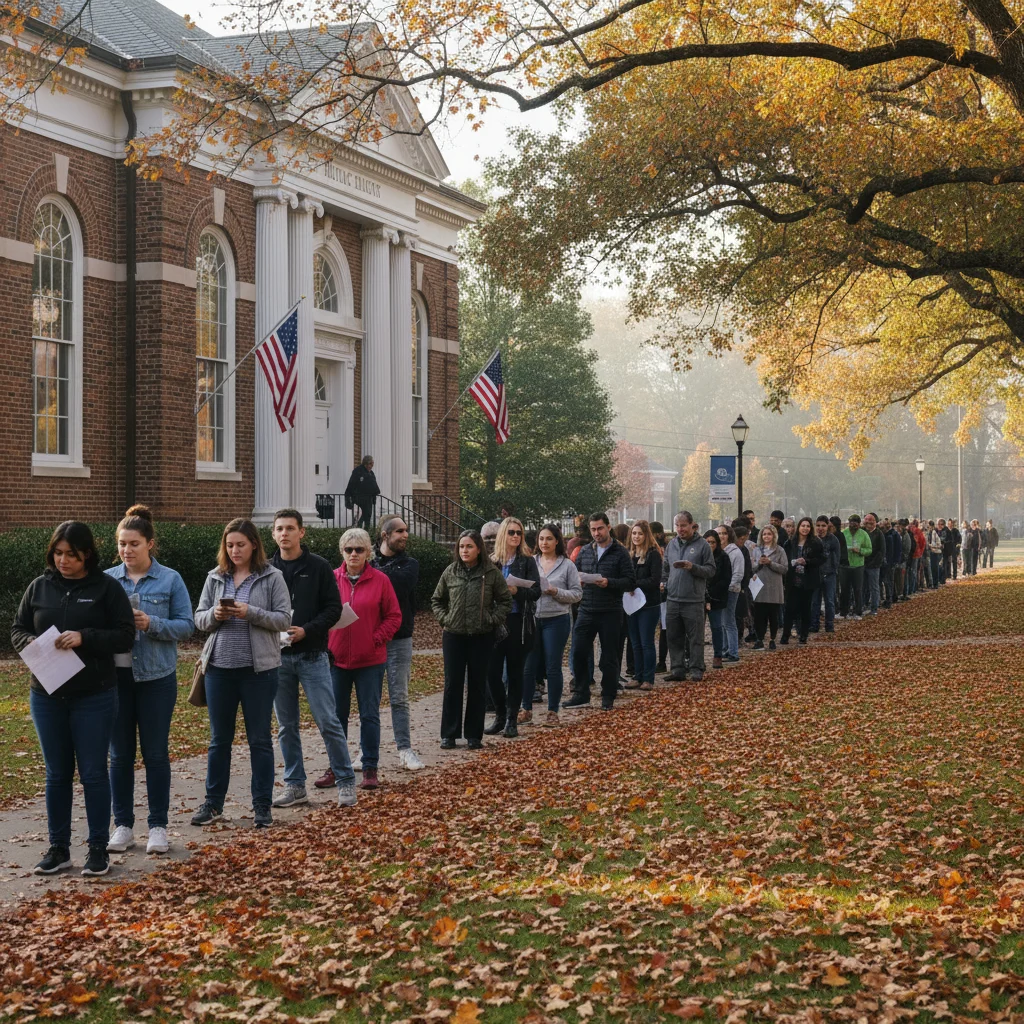
The Early Voting Playbook Has Been Rewritten
The lines at the public libraries in Cobb County, Georgia, started forming before the sun came up on Tuesday. It is a scene playing out across the American South. With just two weeks left until the 2026 midterm elections, early voting data from Georgia and North Carolina is upending traditional campaign strategies. Control of Congress hangs in the balance, and the numbers coming out of these two critical swing states have both parties scrambling to adjust their closing arguments.
For years, political campaigns relied on a simple formula. Democrats built up a massive lead during early voting, while Republicans counted on a furious surge of voters showing up on Election Day. That formula is dead.
In Georgia, more than 1.8 million voters have already cast ballots, according to the Secretary of State’s office. In North Carolina, the figure has topped 1.5 million. But it is who is showing up, and where, that has campaign offices in Atlanta and Raleigh rewriting their scripts for the final fortnight. Republicans are voting early in numbers never seen before, while Democrats are playing defense in suburban strongholds they once thought were secure.
The Republican Shift to the Early Vote
The biggest surprise of the cycle is the GOP’s aggressive embrace of early voting. After years of skepticism toward mail-in and early in-person ballots, the Republican National Committee launched a massive campaign to encourage voters to bank their ballots early. The strategy is working.
“We stopped telling our voters to wait until Tuesday,” said Elena Cruz, a Republican strategist working on congressional races in North Carolina. “If you wait until Election Day, bad weather or a flat tire can keep a voter home. Banking these votes early lets us use our resources to chase down the harder-to-reach voters in the final week.”

In rural Georgia counties, early turnout is outpacing 2022 midterm levels by double digits. This early surge gives the GOP a cushion they have never had heading into the final stretch of a major election. It allows their campaigns to shift television advertising dollars away from broad, expensive broadcast markets and into highly targeted digital ads aimed at moderate swing voters.
Democratic Firewalls Under Pressure
For Democrats, the early numbers are a wake-up call. While turnout remains high in urban centers like Atlanta’s Fulton County and North Carolina’s Wake County, the comfortable margin the party usually enjoys at this stage has shrunk. The traditional Democratic early-vote cushion is thinner than expected.
This shift is particularly clear in North Carolina’s 13th Congressional District, a crucial swing district that features a mix of rapidly growing suburbs and rural communities. Here, independent voters make up the largest bloc, and early voting patterns show them breaking in unpredictable directions.
Get Free $500 Amazon Gift Cards
“We can no longer assume that a high early turnout automatically favors us,” said Marcus Vance, a Democratic strategist based in Charlotte. “The GOP has closed the gap. Our closing argument has to pivot from a generic message of progress to a sharp, urgent warning about what happens if the other side takes total control.”
The Final Fortnight Arguments
These shifting patterns have fundamentally altered how both parties are spending their remaining cash. With the GOP showing strength in early numbers, Democrats are shifting their focus to sporadic voters, particularly young voters and communities of color who have not yet shown up at the polls.

Democratic candidates are dialing up the urgency on reproductive rights, healthcare, and economic stability for working-class families. In Georgia, high-profile surrogates are hitting college campuses and suburban community centers, trying to spark the late-stage enthusiasm that carried the party to victory in recent cycles.
Meanwhile, Republicans are using their early-vote success to project momentum. Their closing arguments have locked onto economic anxieties, inflation, and border security. With a chunk of their reliable base already in the bank, GOP candidates are spending the final two weeks appealing directly to suburban independents who might be weary of political polarization.
What the Numbers Do Not Tell Us
Despite the frantic energy in both camps, analysts warn against drawing definitive conclusions from early turnout data. High turnout does not automatically tell us how people voted, especially with a historic number of registered independents participating in both states.
“We are seeing high engagement, but high engagement is not a proxy for a wave in either direction,” said Sarah Mercer, a nonpartisan polling analyst based in Atlanta. “What we are actually seeing is a fundamental change in voter behavior. People have normalized voting early. It is no longer an outlier activity; it is the default.”
In the final fourteen days, the ground game will decide the outcome. In North Carolina and Georgia, the campaign signs are everywhere, the television ads are relentless, and the stakes could not be higher. Both parties know that the old rules no longer apply, and the winner will be the one who adapts fastest to the new reality of the American electorate.