How Fortnite Tracker’s UEFN Tech Is Reshaping Esports Scouting
Esports scouts are ditching old leaderboards for live UEFN metrics in Chapter 7. Here is how Fortnite Tracker’s new tool is changing the game.
Fortnite Chapter 7 is not just about new map locations or weapon sandboxes. Behind the scenes, the way competitive talent is discovered is undergoing a quiet revolution. For years, esports scouts relied on Power Rankings (PR) and Arena placements to find the next prodigy. Not anymore. Tracker Network has just rolled out its real-time Unreal Editor for Fortnite (UEFN) analytics integration. Suddenly, the old scouting playbook looks ancient.
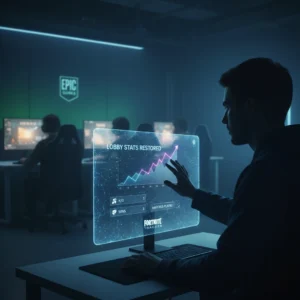
The competitive scene has shifted. Traditional Battle Royale is still the crown jewel, but UEFN custom maps are where players hone their raw mechanics. Until recently, tracking a player’s performance in these custom creative environments was nearly impossible. Scouts had to rely on uploaded VODs or word of mouth. Now, the new tracker changes the equation by pulling live telemetry straight from custom lobbies.
The Death of the Traditional VOD Review
Scouting used to be a tedious grind. You sat through hours of laggy streams. You hoped a player’s Twitch archive did not get deleted. You took messy notes on Google Sheets. Today, everything is different. The new integration allows analysts to see exactly how a player performs in specialized 1v1 maps, box fights, and zone wars without needing to watch a single video.
“We used to sign kids based on a few flashy clips on Twitter,” says Sarah Jenkins, lead talent scout for Legacy Esports. “Then we would get them into team practice and realize they lacked consistency. With these live UEFN metrics, we can see their average edit speed and accuracy under pressure over hundreds of games. The data does not lie.”
Metrics That Actually Matter
The new dashboard does not just count kills. It tracks complex actions that reveal a player’s true skill ceiling. Key data points now include build-to-edit ratios, movement efficiency, and piece-control success rates. It also tracks how quickly a player recovers health after taking damage in intense build battles.
- Actions Per Minute (APM): Measures how fast a player inputs commands during high-intensity build fights.
- Shot Accuracy in Chaos: Tracks aiming precision specifically when the player is falling or building.
- Clutch Ratio: Analyzes survival rates in simulated end-game scenarios with five or more active opponents.
By focusing on these micro-interactions, scouts can identify mechanical geniuses who might not have the patience to grind open-world tournaments but possess the raw talent to dominate in a structured team environment.
The Rise of the Creative Specialist
This technological leap has created a new class of professional players: the UEFN specialist. These are competitors who spend all their time in custom-built competitive modes rather than the standard Battle Royale map. Previously, these players were invisible to major organizations. Now, they are topping the analytics charts.
Tracker Network’s database allows scouts to filter players by specific UEFN map codes. If an organization needs a player who excels in close-quarters box fighting, they can search the leaderboard for that exact map. Within seconds, they have a list of the top fifty performers globally, complete with their raw performance metrics.
A Level Playing Field for Aspiring Pros
This tool is a massive win for players who cannot afford expensive streaming setups or do not have the social media reach to get noticed. All they need is an internet connection and a public Epic Games account linked to Fortnite Tracker. If they have the skills, their numbers will show up on the dashboards of the biggest teams in the world.
The era of relying on hype and clout is fading. In Chapter 7, data is the new kingmaker. For aspiring pros, the advice is simple: stop worrying about your follower count and start focusing on your metrics. Someone is definitely watching.