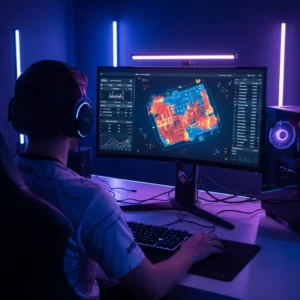
How Fortnite Tracker’s Clutch Factor is Changing Esports Scouting
An AI-powered metric from Fortnite Tracker is reshaping how pro teams scout players ahead of the 2026 FNCS Global Championship.
Competitive Fortnite is chaotic. In the final moving storm circles, dozens of players crowd into tiny, metallic grids, building, tunneling, and trading shotgun blasts in a desperate bid to survive. Traditionally, professional esports scouts looked at basic metrics like average placement and elimination-to-death ratios to evaluate talent. But those raw numbers rarely tell the whole story of who survives when everything goes wrong.
Now, a new analytical tool is shaking up the competitive landscape ahead of the 2026 FNCS Global Championship. Developed by Tracker Network, the new “Clutch Factor” is an AI-driven metric designed to quantify a player’s performance under extreme pressure.
A New Yardstick for Pressure
For years, esports coaches relied on manual VOD reviews to judge whether a player had the mental fortitude to win high-stakes games. It was a subjective process. Tracker Network wants to change that by turning composure into cold, hard data.
The Clutch Factor algorithm assigns players a score from 0 to 100. It doesn’t just look at who wins the match. Instead, it analyzes over 500,000 matches from regional qualifiers, focusing entirely on high-stress variables. The system tracks how a player performs when their health drops below 50, when they are outnumbered in 1v2 or 1v3 situations, and how efficiently they use materials during late-game heal-offs.
“We wanted to solve a specific problem,” says Sarah Chen, lead data scientist at Tracker Network. “Everyone knows who the best mechanical players are. But we wanted to know who makes the smartest decisions when they have ten health, no shield, and five people spraying at their walls. That is what this metric measures.”
How the Algorithm Calculates ‘Clutch’
The AI does not treat all eliminations equally. An elimination secured early in a match on an unarmed opponent grants almost zero weight to the Clutch Factor. Conversely, a siphon-assisted elimination secured during the fifth moving zone while the player is suffering from storm sickness receives massive weight.
Key metrics analyzed by the AI include:
- Resource Efficiency: How many builds a player places per second relative to their remaining material count in the final zones.
- Under-Fire Accuracy: Shotgun and assault rifle accuracy specifically when the player is actively taking damage.
- Siphon Timing: The decision-making speed behind going for an elimination to health-regen versus defensive box-healing.
- Pressure Navigation: Spatial awareness and movement efficiency when surrounded by multiple active enemy layers.
Currently, the average professional Fortnite player holds a Clutch Factor score of 68. Elite players, however, are pushing the absolute limits of the system. According to early data leaked from the closed beta, top-tier pros like Cooper and Cold are registering scores in the high 90s, proving that their late-game dominance is not just luck.
Finding the Next Underrated Star
The real value of this technology lies in scouting unknown talent. Major esports organizations often overlook tier-two and tier-three players who lack the support of a top-tier duo partner or suffer from poor tournament placements due to bad zone RNG.
Marcus “Tectonic” Vance, head scout for esports organization Apex Horizon Gaming, believes this metric will level the playing field. “In the past, we had to guess if an amateur player had potential or if they just got lucky in a few tournament runs,” Vance explains. “Now, I can filter the leaderboard by Clutch Factor. If a 15-year-old kid in Contender Division has a clutch rating of 89, we are signing them immediately. It is a massive shortcut for finding raw talent.”
For the players themselves, the metric is already shifting how they approach practice. 17-year-old competitive player Lucas “Vivid” Patel says the data has changed his training regimen. “I used to just grind creative matches to get my mechanics faster,” Patel says. “Now, I actively practice low-ground, low-material scenarios because I know organizations are looking at my clutch score. You can’t fake it.”
The Road to the 2026 Global Championship
As the road to the 2026 FNCS Global Championship heats up, the implications of this data will extend far beyond team management. Broadcast analysts are planning to integrate live Clutch Factor telemetry into the official tournament streams, giving viewers a real-time look at which players are most likely to survive the final circles.
Whether this AI metric can truly predict the next world champion remains to be seen. But in a game where milliseconds and single-digit health pools decide millions of dollars, having a number to quantify human grit might just be the edge teams need.