How Fortnite’s Dynamic Pricing Is Changing the In-Game Economy
Epic Games is rewriting the rules of the Fortnite Item Shop. Here is how the shift away from traditional rarity tiers impacts your V-Bucks.
The End of Color-Coded Cosmetics
For years, Fortnite players knew exactly what their V-Bucks were worth. You saw a gold background, you knew it was a Legendary skin costing 2,000 V-Bucks. Purple meant Epic for 1,500. Blue was Rare at 1,200. It was a simple, predictable system. It worked well. But as Epic Games prepares for the launch of Chapter 7, that classic color wheel is officially dead.
Epic Games quietly retired the traditional rarity tiers earlier this year. In their place is a more fluid, dynamic pricing model. This change has fundamentally altered how players interact with the Item Shop. Instead of fitting skins into rigid price brackets, Epic now prices cosmetics based on their individual features, cross-game compatibility, and licensing costs.
Why Epic Dropped the Classic Tiers
The decision to abandon the classic rarity colors wasn’t just a cosmetic UI cleanup. It was a strategic economic pivot. As Fortnite expanded from a single battle royale into a sprawling platform hosting LEGO Fortnite, Rocket Racing, and Fortnite Festival, the old system broke down.
Under the new dynamic model, a single skin often needs to function across multiple entirely different game modes. A skin might include:
- A highly detailed battle royale avatar
- A custom-designed LEGO minifigure style
- Exclusive instruments or tracks for Fortnite Festival
- Special reactivity or physics elements
Developing these multi-use assets requires significantly more labor. Epic argued that the old rarity labels didn’t accurately reflect the work going into these cosmetics. By dropping the colors, the publisher gained the freedom to price items based on their real utility across the expanding Fortnite ecosystem.
How Dynamic Pricing Affects Your Wallet
For the average player, the immediate result of this change is unpredictable pricing. Some items that would have previously been classified as Rare now command higher price tags because they come bundled with extra digital styles or LEGO compatibility. Conversely, some basic skins are cheaper than they might have been under the old system.
The Community Pushback
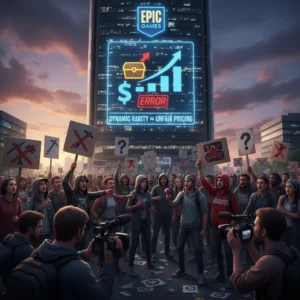
Not everyone is happy. Social media platforms like Reddit and X are regularly filled with complaints about “price creep.” Players point to recent collaborative skins that cost upwards of 1,800 V-Bucks without including any back bling or harvesting tools. Previously, a skin at that price point almost always came with a complete set of accessories. Now, players are forced to buy those items separately, driving up the total cost of a complete look.
But the community has not met these changes with universal frustration. The new model has made bundles much more consumer-friendly. Epic’s dynamic bundling algorithms now calculate custom discounts on the fly. If you already own a pickaxe or a glider from a specific set, the game automatically slashes the price of the remaining bundle. This keeps players engaged and spending, even if they only want a fraction of a new release.
Preparing for Chapter 7
This economic shift is not happening in a vacuum. It is a foundation for what is coming next. With Chapter 7 on the horizon, Epic is positioning Fortnite as a permanent metaverse rather than a seasonal game. This requires a mature, flexible economy that can handle complex intellectual property crossovers without being restricted by decades-old pricing tiers.
Collaborations with massive brands like Disney, Star Wars, and Marvel are becoming more deeply integrated. These brands demand specific pricing structures that do not always align with Fortnite’s historic 800-to-2,000 V-Buck system. Dynamic pricing allows Epic to negotiate custom royalty splits and set prices that keep external partners happy while keeping the digital shelves stocked.
Ultimately, the era of predictable Fortnite cosmetic prices is over. The Item Shop has evolved into a real-time marketplace. As Chapter 7 approaches, players will have to get used to evaluating skins based on their actual value in the game, rather than the color of the background behind them.