Flick’s Midfield Puzzle: Tactical Takeaways From Vallecas
Hansi Flick faces a crucial midfield dilemma following Marc Bernal’s injury and Dani Olmo’s debut in Barcelona’s tight win over Rayo Vallecano.
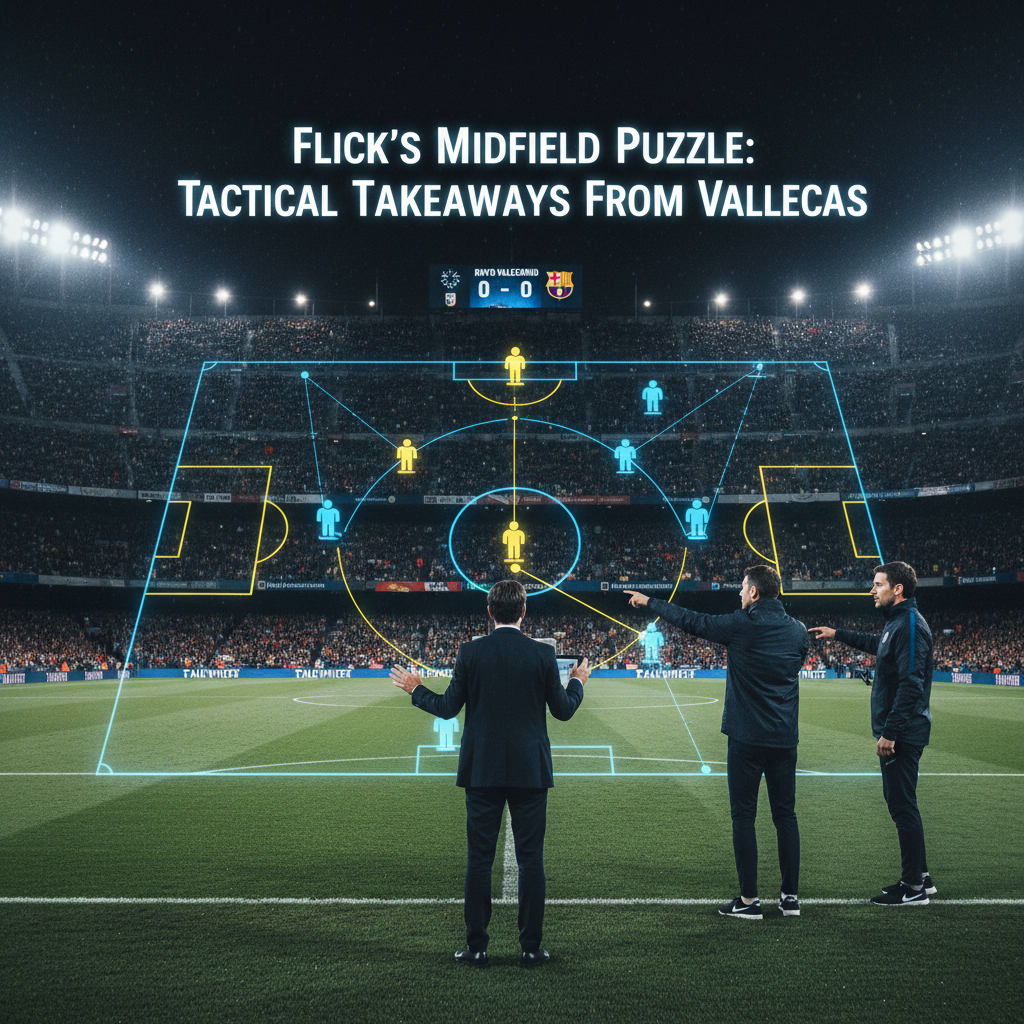
Vallecas is never an easy place to play. For Hansi Flick’s Barcelona, the trip to Madrid was a trial by fire. It was a game of two distinct halves, ending in a hard-fought victory but leaving behind a trail of tactical questions. With the transfer window closing in a matter of hours, the German manager is facing a midfield puzzle that requires immediate answers.
Ditching the Single Pivot
Flick’s tactical blueprint is clear. He has benched the traditional Catalan 4-3-3 in favor of a more direct, energetic 4-2-3-1. In this setup, the double pivot is the engine room. Against Rayo, we saw this system at its most vulnerable, and later, at its most devastating.
The first half was a struggle. Without a natural anchor, Barcelona struggled to progress the ball. Rayo’s aggressive high press choked the supply lines. Pedri looked isolated. Young Marc Casadó fought hard but lacked the physical presence to dominate transition phases. It was a stark reminder of what Barca lost when Sergio Busquets departed, and what they still lack today.
Flick wants verticality. He hates useless sideways passing. Under his watch, Barca must get the ball forward as fast as possible. This requires midfielders who can turn under pressure and play forward instantly. In the first half, the passing was slow. Rayo Vallecano’s coach, Iñigo Pérez, set up a brilliant mid-block that cut off the passing lanes to the wingers. Robert Lewandowski was starved of service. The double pivot of Casadó and Bernal struggled to find the half-spaces.
The Dani Olmo Factor
Then came Dani Olmo. Registered at the eleventh hour, the summer signing replaced Ferran Torres at halftime and completely flipped the script. Olmo didn’t play as a winger; he operated as a true number ten. He drifted between the lines, picked up the ball in tight spaces, and ran directly at the Rayo defense. His presence liberated Pedri, who could drop deeper to dictate play without being swarmed. It was a masterclass in tactical adaptability.
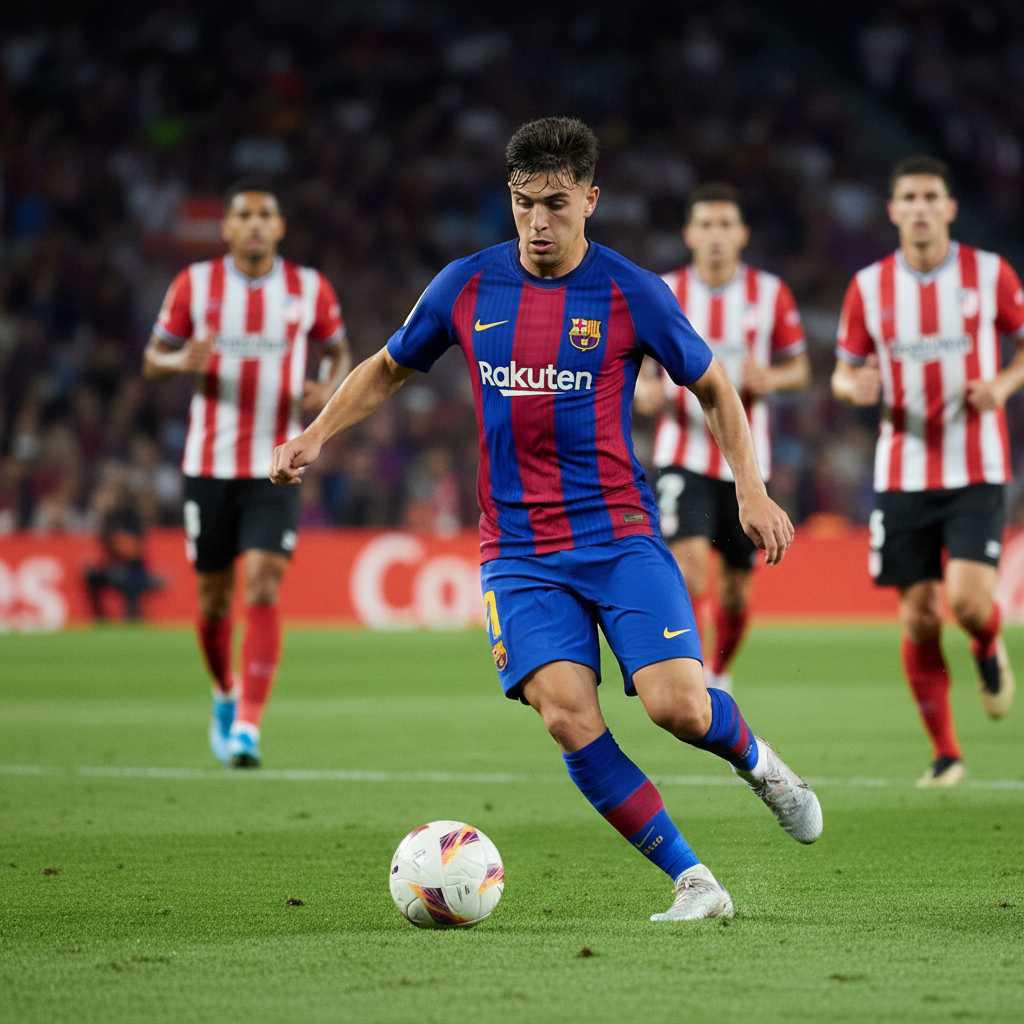
Olmo’s introduction changed the geometry of the pitch. He constantly demanded the ball in tight spaces. When Olmo received the ball, Rayo’s central defenders had to step out, leaving space for Lamine Yamal and Raphinha to exploit. Pedri also benefited immensely. Free from the burden of carrying the ball forward himself, the Canary Islander sat deeper, pulling the strings like a veteran quarterback. His late equalizer was proof of his renewed attacking license under Flick.
The Injury Blow and Transfer Dilemma
But the night ended on a bittersweet note. Marc Bernal, the 17-year-old sensation who had started the season so brightly, limped off with a serious knee injury. It’s a massive blow. Bernal was the glue in Flick’s double pivot, showing maturity beyond his years.
With Bernal out and both Frenkie de Jong and Gavi still recovering, Flick’s midfield depth is paper-thin. The board, led by sporting director Deco, has very little room to maneuver under La Liga’s strict financial rules. Do they scramble for a late loan signing? Or does Flick look inward, perhaps converting Eric Garcia into a temporary holding midfielder?
If no one arrives, Flick must get creative. Andreas Christensen has played in midfield before, but he is currently nursing an injury of his own. Eric Garcia is the most realistic in-house solution. Garcia played a similar hybrid role under Michel at Girona last season and has the technical security Flick craves, even if he lacks raw physical power.
The tactical takeaway is clear. Flick has built an exciting, vertical attacking machine, but its foundations are incredibly fragile. One injury can throw the entire system out of equilibrium. As Barcelona prepares for the long grueling stretch of the season, the manager’s ability to rotate and adapt will be tested to its absolute limit.