Fortnite Tracker’s UEFN Tools Change Map Monetization
Fortnite Tracker launches UEFN Creator Analytics, helping custom map makers maximize their Chapter 7 payouts with deep engagement data.
Fortnite Chapter 7 is finally here. With it comes a massive wave of new content, map changes, and weapon updates. But the biggest shift isn’t happening on the official Battle Royale island. It is happening behind the scenes, where thousands of independent developers are building their own mini-games using the Unreal Editor for Fortnite (UEFN).
For a long time, these creators worked in the dark. Epic Games paid them based on player engagement, but finding out what actually kept players hooked was mostly guesswork. That is changing. Tracker Network, the company behind the widely popular Fortnite Tracker database, has launched a suite of UEFN Creator Analytics. It is designed to give custom map makers the exact data they need to maximize their payouts in Chapter 7.
The Black Box of Engagement Payouts
Epic Games distributes millions of dollars every month to creators through its Creator Economy 2.0 system. Payouts are calculated using a complex formula. It factors in player retention, active play sessions, and how well a map attracts new users. But Epic’s own backend tools have historically offered limited data. Creators could see how many people played their maps, but not necessarily why they stayed—or why they left.
This lack of clarity made monetization a trial-and-error process. Map makers often spent weeks building updates, only to watch their player counts—and their monthly checks—plummet without explanation. The new tools from Fortnite Tracker aim to eliminate this guesswork entirely by turning raw player data into actionable design decisions.
What the New Analytics Dashboard Offers
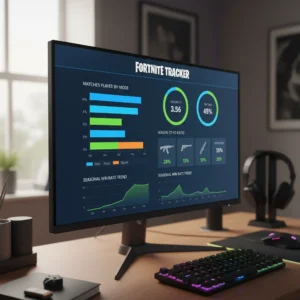
The updated Tracker Network platform hooks directly into public-facing data streams, presenting them in a highly readable dashboard. Instead of just showing simple player spikes, the analytics platform tracks deep engagement metrics. This includes average session lengths, concurrent user trends, and regional popularity shifts.

One of the most valuable features is the retention tracking tool. Map makers can now see how many players return to their map day after day. In the world of UEFN, a returning player is worth far more than a one-time visitor. By understanding when and why players return, creators can tweak their progression systems or daily challenges to keep their audience coming back.
“We used to spend weeks guessing why a map failed to hold an audience,” says Julio Alvarez, a veteran custom map designer who has been testing the beta version of the tracker. “Now, we can see the exact day player interest drops. If people leave on day three, we know our progression system is too grindy. It completely changes how we design our updates.”
Surviving the Chapter 7 Economy
Chapter 7 has introduced new competitive mechanics and visual upgrades that have raised the bar for what players expect from custom experiences. Standard red-versus-blue arenas are no longer enough to secure a steady stream of income. The market is saturated. Players have thousands of high-quality maps fighting for their attention every single day.
To survive, creators must run their maps like actual live-service games. Fortnite Tracker’s new suite helps them do exactly that. The dashboard includes a payout estimator that projects monthly earnings based on current engagement trends. While not an official Epic Games calculator, it gives developers a highly accurate benchmark to gauge their financial health before the official monthly statements arrive.
Data-Driven Game Design is the Future
The introduction of these analytics marks a maturity phase for the Fortnite creative ecosystem. What started as a simple sandbox mode has evolved into a multi-million-dollar industry. Professional studios are now forming specifically to build games inside Fortnite, and they require the same level of analytical tools that traditional game developers use on Steam or consoles.
With Fortnite Tracker leveling the playing field, smaller independent creators now have access to the same quality of data as major creative studios. The creators who learn to read these numbers will be the ones who dominate the Chapter 7 charts. Those who rely on luck may find themselves left behind in the lobby.